
July 6, 2026
ISBN Database Access and Other Open Reference Data in Bulk
An ISBN database lookup — title, authors, publisher, editions from a bare ISBN — is the classic reference-data problem: the data is public, but bulk access isn't. This guide covers structured exports from eight open reference sources: books, academic works, artworks, species records, recipes, and AI model benchmarks.
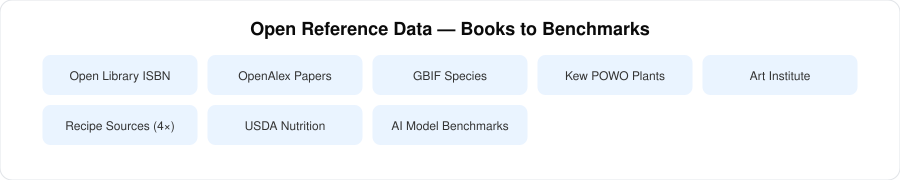
ISBN database lookups from Open Library
The Open Library ISBN scraper resolves ISBN lists to full book metadata — title, authors, publisher, publish date, page count, subjects, covers. Feed it a catalog's worth of ISBNs and get one record per book; a free ISBN database download in practice, without parsing Open Library's full data dumps. The companion author bibliography scraper inverts the lookup: give it authors, get their works.
Academic works metadata from OpenAlex
The OpenAlex crawler exports scholarly-work records — papers with authors, institutions, citations, and concepts — from the open successor to Microsoft Academic Graph. Bibliometrics projects and research-tool builders use it as their base layer.
Species occurrence records from GBIF
The GBIF scraper exports biodiversity data — species occurrence records with coordinates, dates, and taxonomy — from the Global Biodiversity Information Facility. The Kew POWO scraper adds authoritative plant taxonomy from the Royal Botanic Gardens' Plants of the World Online.
Museum collections: Art Institute of Chicago
The Art Institute artworks scraper exports collection records — artist, date, medium, dimensions, image links — from one of the best museum APIs. Art-market research and dataset builders get a clean cultural corpus without touching the raw API's paging.
Recipe data at scale
Recipe corpora power nutrition apps and ML training sets. Four sources with different strengths: BBC Good Food (tested editorial recipes), NYT Cooking, Chefkoch (the German-language giant), and the recipe JSON-LD harvester, which extracts schema.org recipe markup from any site list. The USDA nutrition enricher then maps ingredients to FoodData Central nutrition facts.
AI model benchmarks from Artificial Analysis
The Artificial Analysis scraper exports LLM benchmark data — quality scores, speed, and price per model over time. Teams tracking the model market pull it on a schedule and keep the time series their procurement decisions reference.
Reference data source summary
| Domain | Source | Key fields |
|---|---|---|
| Books | Open Library (ISBN + author) | Title, authors, editions, subjects |
| Academic papers | OpenAlex | Citations, institutions, concepts |
| Biodiversity | GBIF, Kew POWO | Occurrences, taxonomy |
| Artworks | Art Institute of Chicago | Artist, medium, images |
| Recipes | BBC GF, NYT, Chefkoch, JSON-LD harvester | Ingredients, steps, nutrition |
| AI models | Artificial Analysis | Quality, speed, price benchmarks |
The enrichment pattern
Reference data is rarely the product — it enriches something else. The pattern: keep your key column (ISBNs, DOIs, species names, ingredient lists), run the matching scraper over it, and join the results back. Per-record pricing means enriching a 10,000-row catalog costs what 10,000 lookups cost, and monthly refreshes only re-run the rows that changed.
Browse the full AI & Data catalog — 120+ actors from sports odds to satellite fleets.