
July 5, 2026
How to Get Skip Tracing Data at Scale: People-Search Lookups in Bulk
Skip tracing data — current addresses, phone numbers, relatives, and property links for a named person — normally means paying per lookup on a people-search site, one name at a time. This guide covers how to run those lookups in bulk against five people-search sources and what each returns.
Who needs bulk skip tracing
Three groups run into the same wall. Real-estate investors trace property owners from county records to a callable phone number — a motivated-seller list of 500 parcels means 500 lookups. Debt-recovery and legal-support teams locate defendants and judgment debtors, where a stale address means a failed service attempt. And B2B lead builders enrich contractor or owner-operator lists — a name like "Smith Roofing" resolves to an owner, and the owner resolves to contact data.
Doing this through a people-search website means typing one name at a time into a search box. Doing it through a data broker means an enterprise contract. The middle path: run the same searches programmatically and pay per record.
Build the candidate list first
The Spokeo people search scraper is the breadth source: give it a name and a US state and it returns every match Spokeo lists, not the handful the site puts on page one. Spokeo caps a state result page at around 30 people, so the scraper walks metro and city sub-pages to lift that past 100 unique people per query. Each record carries name variants, current and prior locations, an address array and related persons — enough to pick the right candidate before you spend a lookup resolving them. It does not return phone numbers or emails; the sources below do.
FastPeopleSearch lookups in bulk
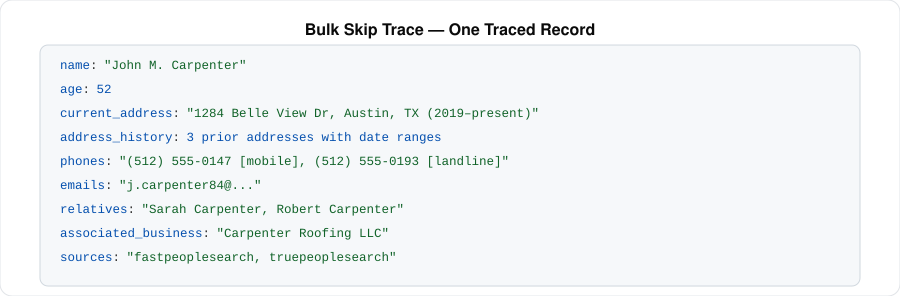
The FastPeopleSearch scraper targets one of the highest-coverage free people-search sites. Search by full name plus location and get current and past addresses, phone numbers, relatives, and age. It handles the site's anti-bot measures for you, which is where DIY scripts usually die.
TruePeopleSearch data export
The TruePeopleSearch scraper covers the other major free source. Records include address history, landline and mobile numbers, email addresses, and possible relatives — useful as a cross-check against FastPeopleSearch results, since the two sites disagree often enough to matter.
FastBackgroundCheck and AnyWho as verification layers
Two more sources round out coverage. The FastBackgroundCheck scraper adds background-flavored records (aliases, address timelines), and the AnyWho scraper covers the directory-style data descended from phone-book listings. Running a traced list through a second source is the cheapest way to raise phone-number hit rates before a call campaign.
What a bulk skip trace returns
| Field | Typical coverage | Notes |
|---|---|---|
| Current address | High | With move-in date ranges |
| Address history | High | Useful for judgment-debtor timelines |
| Phone numbers | Medium–high | Mobile vs landline flagged |
| Email addresses | Medium | Better on younger records |
| Relatives / associates | High | Household and family links |
| Age / DOB range | High | Disambiguates common names |
Common names are the main accuracy risk: "John Smith" returns pages of candidates, so pass a city or an age hint whenever you have one — the scrapers accept them as optional inputs and the match rate improves sharply.
Compliance notes before you run a trace
People-search data in the US is generally drawn from public records, but what you may use it for is regulated. FCRA draws the line: employment, credit, insurance, or housing decisions require a consumer-reporting agency, which these sources are not. Collections outreach falls under FDCPA and TCPA calling rules. Investor and lead-gen use is the mainstream case — know your category before you dial.
Cost compared to per-lookup services
Skip-tracing services quote $0.10–0.25 per record with minimum batch sizes attached. The scrapers above price per record with no batch minimum, so a 500-name trace costs what 500 lookups cost, whether you run it once or every week.
Choosing between sources — which ones return emails, which accept a reverse phone, email or address lookup, and which cover Canada, France, Germany and Sweden — is laid out side by side in People Search Data in Bulk.
For company-level contact building (registered agents, directors, PEC addresses), the registry route is often stronger — see How to Get Company Registry Data in Bulk, or browse the full Lead Generation catalog.