
July 6, 2026
Technical Data Utilities: DNS Audits, SSL Checks, Satellite Elements, and Bulk Parsing
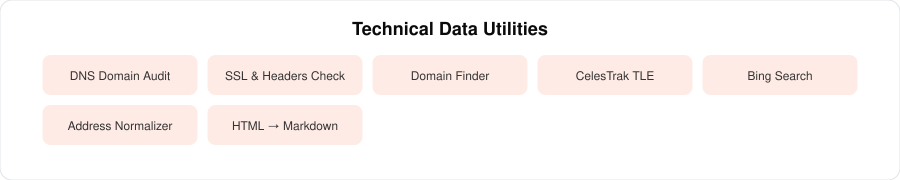
Some data problems aren't about a website — they're about infrastructure: what a domain's DNS actually resolves, whether TLS is configured sanely, where a satellite is right now, or how to normalize a million messy addresses. This guide covers seven utility actors that solve technical-data problems in bulk.
DNS domain audit in bulk
The DNS domain audit resolves a domain list into full DNS posture: A/AAAA/MX/TXT/NS records, mail configuration (SPF, DKIM, DMARC), and nameserver setup. Security teams sweep vendor lists with it; marketers verify sending domains before campaigns; M&A diligence checks a target's whole domain portfolio in one run.
SSL and security headers checker
The SSL & security headers checker grades TLS configuration and HTTP security headers for a URL list — certificate validity and expiry, protocol versions, HSTS, CSP, and the rest. Run it monthly over everything you own and expiring certs stop being surprises.
Domain name finder
The domain name finder checks name availability in bulk across TLDs — the naming-sprint tool that turns a 200-candidate brainstorm into the 12 actually available options.
Satellite orbital elements from CelesTrak
The CelesTrak TLE scraper exports two-line orbital elements for the tracked satellite catalog — the dataset every pass-prediction and conjunction tool propagates from. Fetch by constellation or catalog number and get current TLEs without hand-parsing text files.
Bing search results as data
The Bing search scraper exports search results — rank, title, URL, snippet — for a query list. SEO rank tracking is the obvious use; the less obvious one is using result counts and domains as a research instrument over any topic list.
Bulk address parsing and normalization
The address parser & normalizer takes freeform address strings and returns structured components — street, city, region, postal code — normalized for matching. It's the unglamorous step that makes every property, lead, or registry dataset joinable.
HTML to Markdown, translation, and summarization
Two content utilities finish the set: the HTML-to-Markdown reader converts page lists into clean Markdown (the preprocessing step for LLM pipelines), and the AI translator & summarizer runs translation or summarization over document batches.
Utility summary
| Problem | Actor | Output |
|---|---|---|
| Domain security posture | DNS domain audit | Records, SPF/DKIM/DMARC |
| TLS hygiene | SSL & headers checker | Grades, expiry dates |
| Name availability | Domain name finder | Available domains by TLD |
| Satellite tracking | CelesTrak TLE | Orbital elements |
| Search results | Bing search scraper | Ranked SERPs |
| Address cleanup | Parser & normalizer | Structured components |
| LLM preprocessing | HTML→Markdown, translator | Clean text |
Utilities compose
These actors earn their keep inside pipelines rather than as destinations: normalize addresses before joining property data, audit DNS before an outreach send, convert pages to Markdown before an extraction pass. Each prices per record, so the utility step adds cents to a workflow, not a subscription.
Browse the full Developer Tools & Utils catalog.