
July 5, 2026
NPI Database Download: How to Get Healthcare Provider Data in Bulk
The national NPI database (NPPES) holds a record for every US healthcare provider — 8 million+ NPIs with name, taxonomy, practice address, and enrollment details. This guide covers how to download NPI data filtered to the providers you actually want, and how to enrich it from six other provider sources.
Search the national NPI database by specialty and state
CMS publishes the full NPPES file as a 10 GB monthly dump — most projects need a filtered slice, not the whole thing. The NPPES NPI crawler queries the registry directly: filter by taxonomy code, specialty, state, or city and get just those providers as clean JSON — NPI, name, credentials, practice and mailing addresses, phone, and taxonomy list. A "physical therapists in Ohio" pull returns in minutes and skips the dump-parsing project entirely.
Cross-check enrollment with Medicare PECOS
An NPI record proves a provider exists; it doesn't prove they bill Medicare. The PECOS enrollment crawler checks Medicare enrollment status per provider — the field that matters for referral networks and DME marketing, where a non-enrolled provider is a dead lead.
Add procedure volumes from CMS utilization data
The CMS provider utilization crawler pulls Medicare Part B utilization per provider: procedure codes, service counts, and payment totals. This is how you rank a specialty list by actual clinical volume instead of guessing from directory listings.
Hospital data: quality scores and price transparency
Two hospital-level sources complement the provider files. The CMS hospital crawler exports hospital profiles with quality ratings, and the hospital price transparency scraper pulls the machine-readable price files hospitals must publish — negotiated rates by payer, the dataset behind most payer-benchmarking work.
Patient-facing directories: Healthgrades and Psychology Today
Registry data lacks the consumer layer — ratings, bios, accepted insurance. The Healthgrades scraper adds ratings and review counts per physician, and the Psychology Today scraper covers the largest therapist directory: modality, fees, insurance, and contact details by city and specialty.
Financial relationships and prescribing signals
For compliance and market-intelligence work, two more CMS-adjacent sets: the Open Payments crawler exports industry payments to physicians (who received what from which manufacturer), and the ClinicalTrials.gov crawler links providers and institutions to active trials — a strong signal for research-active physicians.
Which provider source do I need?
| Need | Source |
|---|---|
| Provider universe by specialty/state | NPPES NPI registry |
| Medicare-billing verification | PECOS enrollment |
| Procedure volume ranking | CMS utilization |
| Hospital quality + pricing | Hospital crawler, price transparency |
| Consumer ratings layer | Healthgrades |
| Therapist directory | Psychology Today |
| Industry payments | Open Payments |
| Research activity | ClinicalTrials.gov |
The pipeline pattern: NPI as the join key
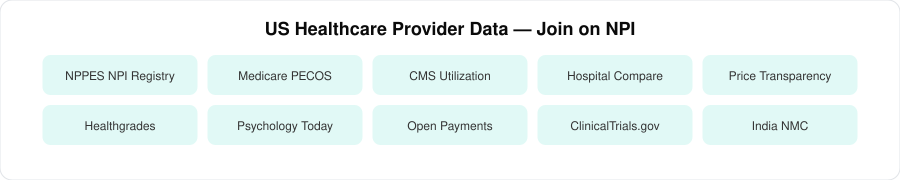
Every US provider source keys on NPI, so the standard pipeline is: pull the filtered NPI universe first, then enrich per-NPI from PECOS, utilization, Open Payments, and the directories. Each scraper prices per record, so a 5,000-provider specialty file with two enrichment passes costs what 15,000 lookups cost, and the refresh next quarter reruns the same inputs.
International coverage follows the same pattern — for example the India NMC doctor registry scraper exports India's national medical register. Browse the full Healthcare catalog for the rest, or see How to Get Company Registry Data in Bulk for the corporate-side equivalent of this playbook.